By Max Deck Print | Product development guide | September 2026
Educational flash card design should start with what a learner does, not just what information appears on each card. A deck can be attractive and accurate yet feel repetitive if every session is the same drill, the task is too difficult or the adult has to invent all the activities.
For educational brands, the product includes instructions, progression and feedback as well as the cards themselves. The goal is a resource with a clear use, not a promise that buying a deck will automatically improve learning.
What is the specific learning task?
Distinguish recognizing a picture, recalling a word, explaining an idea and using it in a new sentence. Those tasks are related, but they are not interchangeable. A card that shows a picture and its answer on the same face may support discussion; it does not require the same recall as a question with the answer hidden.
Carnegie Mellon University’s guidance on retrieval practice describes recalling information from memory as a learning activity and emphasizes aligning question types with learning goals. It also identifies feedback as useful. That supports designing a clear task and response, not making untested claims about a particular commercial deck.
Why can a useful idea become a boring product?
The issue may be repetition without progress, not repetition itself. A learner can lose the reason to continue when every card asks for the same easy response. At the other extreme, a deck that assumes too much reading or background knowledge can turn every turn into a correction.
Define the intended starting level in plain language. “For learners beginning to name common vehicles” is more informative than “for all ages.” Where an age range is used, it should fit the actual content and be reviewed appropriately; it is not a substitute for understanding the user’s abilities.
| Activity | What the learner does | Support to include |
|---|---|---|
| Name it | Recalls a word from a picture | An answer the adult or learner can check |
| Sort it | Groups cards and explains a choice | Example categories and room for reasonable alternatives |
| Use it | Uses a word in a sentence or situation | A model response, not only a right/wrong label |
| Describe it | Gives clues without showing the card | A clear turn structure and vocabulary support |
Can one deck support different sessions?
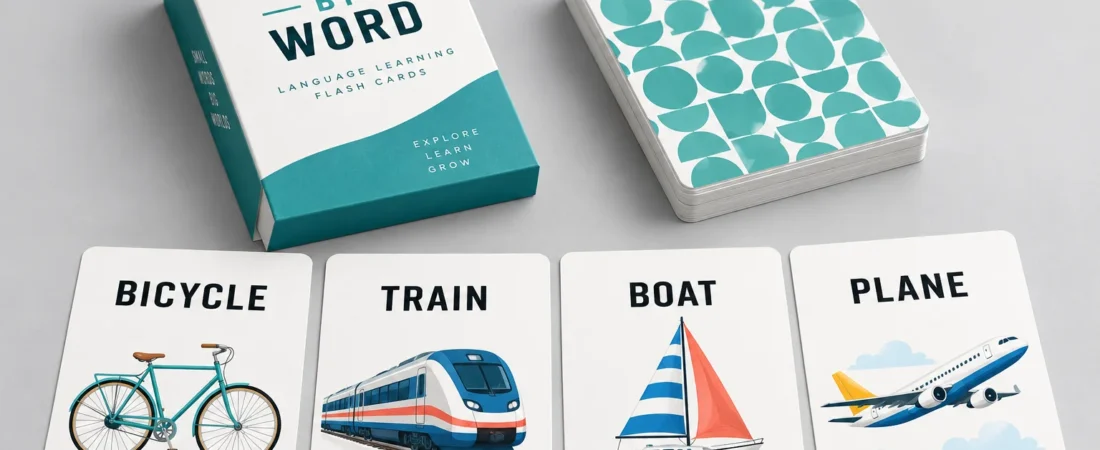
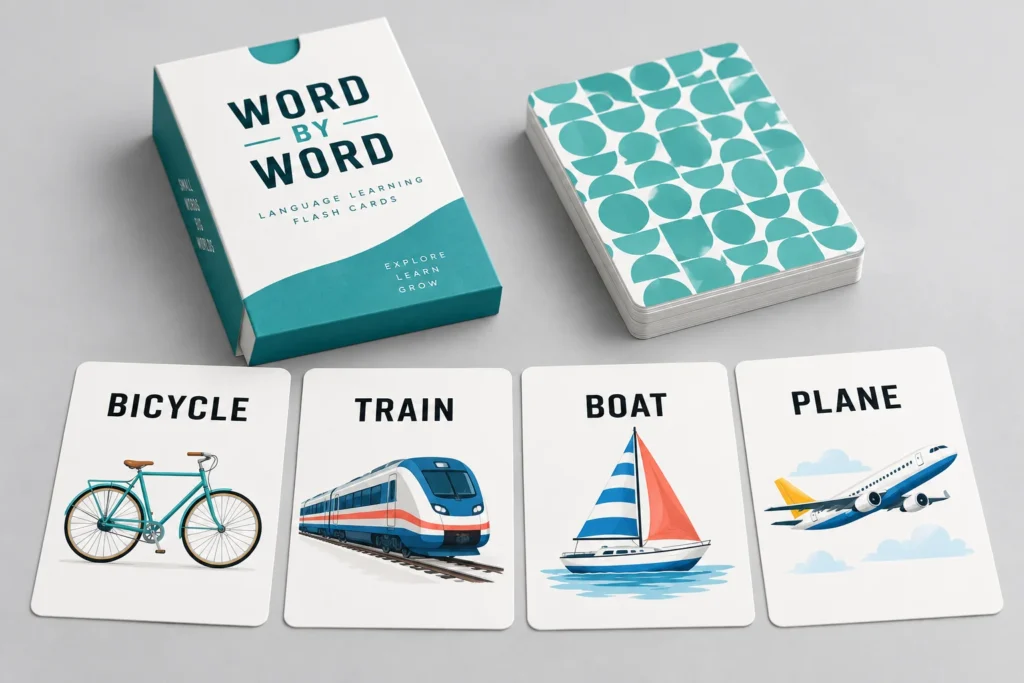
Yes, when the activities are designed around the same content. Consider a hypothetical transport vocabulary deck. A first session could name familiar pictures; another could group vehicles by where they travel; a later activity could describe a journey. The activities ask for different uses of the vocabulary without pretending that a larger card count is automatically better.
Label these as suggested activities rather than evidence of educational effectiveness. Avoid adding a speed competition simply to make the deck feel like a game. Some users may enjoy it; others may need thinking time or a cooperative format. Give the adult a choice.
What does a parent or teacher need from the product?
A resource can be well designed for a child but awkward for the person leading the session. Put a ready-to-use activity on the instruction card: what to select, what to ask, how to respond and when to stop. State whether an adult is expected to participate.
Explain how to revisit difficult items without presenting the exercise as failure. Consider a simple separation between items to practise again and items the learner is ready to use in a different task. Do not prescribe a universal schedule or claim guaranteed results. The right pace depends on the learner and the purpose.
How should you test the product before launch?
- Ask an appropriate educator to review factual content, task fit and instructions.
- With suitable supervision and consent, observe intended users trying a short activity.
- Record confusion about the task separately from incorrect subject answers.
- Ask the adult to start a second activity without help from the creator.
- Revise overloaded cards, unclear instructions and activities with no useful feedback.
Informal testing can identify usability problems. It is not a controlled study and should not be advertised as proof that the deck improves memory, grades or development.
Frequently asked questions
Are more cards better value for an educational deck?
Only when the extra content supports the intended learning scope. A smaller, well-organized set with usable activities may be a clearer product than a large undifferentiated stack.
Should every card have an answer on the back?
Not necessarily. Recall cards, discussion prompts and sorting cards have different needs. Choose the information layout around the activity and how feedback is provided.
Build around the activity
Review custom flash and learning card formats, then request a project quote with your card count, activity instructions and storage needs. Max Deck Print provides custom printing and packaging from 1,000 complete sets. Educational content review and any learning claims remain the publisher’s responsibility.