By Max Deck Print | Buyer guidance | September 2026
Size a card game box around the complete packed contents, not just the nominal card dimensions. Sleeves, finished card thickness, dividers, rules and the insert can all change the space required. Approve a physical fit test before treating the packaging dimensions as final.
A box can look excellent in a render and still fail during use. The lid lifts after players sleeve the cards. A tightly fitted insert traps a deck. The rulebook fits only when folded the wrong way. These are packaging-specification problems, not artwork problems.
Why does a box fit bare cards but not sleeved cards?
Sleeves add dimensions around each card and increase the volume of the complete stack. The result depends on the exact sleeve construction, not just whether the packaging says “standard size.” Single sleeves, double sleeves and resealable inner sleeves should not be treated as interchangeable.
For a concrete manufacturer example, Dragon Shield lists different single- and double-sleeved capacities for the same Deck Shell. That illustrates why a card count needs a sleeve condition. Those capacities belong to that product and should not be copied as dimensions or capacity claims for a custom box.
Which measurements should the packaging supplier receive?
Provide the finished card size, the complete number of cards and an actual packed reference wherever possible. Specify whether sleeves are supplied with the product, added later by players, or excluded from the fit requirement. Include the sleeve brand and model if compatibility matters.
| Part of the set | What to define |
|---|---|
| Cards | Finished size, quantity and intended stock and finish |
| Sleeves | None, single or double; exact reference when applicable |
| Printed rules | Finished dimensions, page count and folded or bound form |
| Dividers and inserts | Quantity, material, compartment layout and removal access |
| Other contents | Only components included in the confirmed supply scope |
| Future storage | Any stated allowance for expansions or accessories |
Distinguish internal usable space from external box dimensions. Wall thickness, folds and the insert occupy space. A matching exterior measurement on two box styles does not guarantee the same usable capacity.
Can stack height be calculated before sampling?
A calculation can help plan a first structure, but it should not replace a finished-deck measurement. For an illustrative calculation, 100 cards with an assumed finished thickness of 0.32 mm give a nominal bare stack of 32 mm. That is not a recommended box depth: sleeves, natural stack variation, rules and removal clearance remain unaccounted for.
Measure a representative complete stack using a consistent method without compressing it to an unrealistic thickness. Ask the supplier how much clearance is suitable for the chosen structure. There is no universal extra millimeter allowance that makes every tuck box, rigid box and insert work.
What should the physical fit test check?
- Load the complete contents in the intended order, including rules and dividers.
- Use the specified sleeves if sleeved storage is part of the requirement.
- Close the lid or tuck flap without bowing the panels or forcing the contents.
- Remove and repack the deck repeatedly to check access and edge catching.
- Check whether normal handling lets the cards escape their compartment.
- Record the tested configuration and approve the structure before final artwork release.
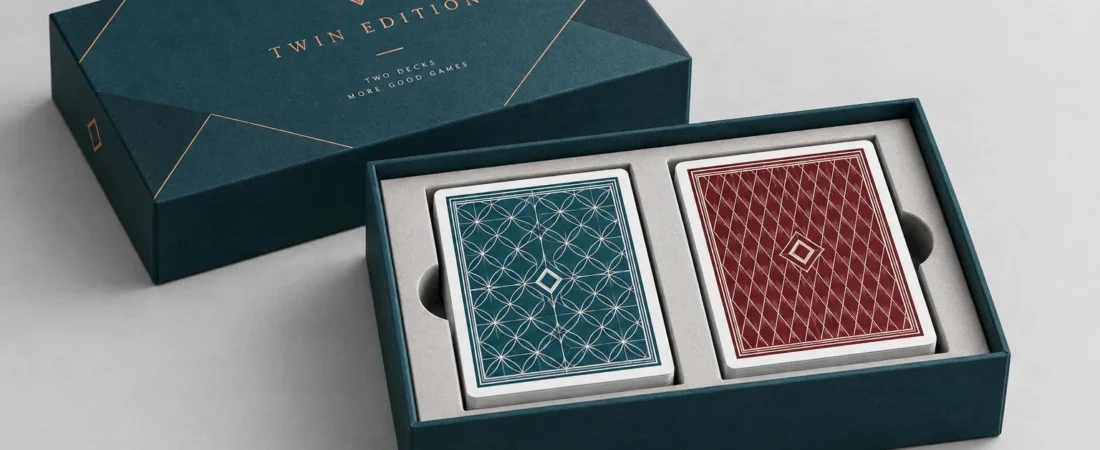
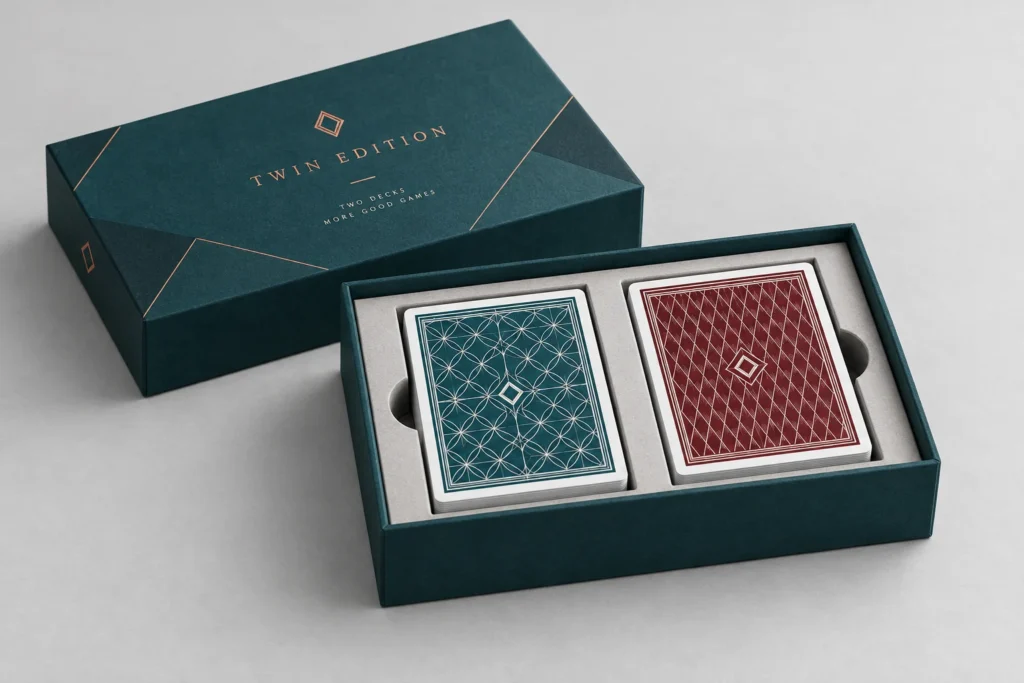
For a two-deck set, test each compartment independently. A generous overall box can still contain an undersized compartment. A thumb cutout may improve access, but it must be evaluated together with the insert material and the card arrangement.
Should the box include space for future expansions?
Only promise expansion storage when the capacity is defined and tested. State how many additional cards, which sleeves and whether original components remain in place. Unspecified spare space can create a larger shipping package without delivering a useful storage benefit.
When the future contents are uncertain, consider a clearly described base-game box and a separate expansion package. Compare the packing and shipping implications with the supplier before deciding.
Frequently asked questions
Can I reuse an old box dieline after changing card stock?
Do not assume it will still fit. A stock, coating, card-count or rulebook change can alter the complete packed size. Recheck the structure before reusing the artwork.
Does “fits 100 cards” mean 100 sleeved cards?
Not unless the specification says so. State the sleeve condition and reference model, then confirm the complete packed configuration.
Can a digital mockup confirm box capacity?
No. A mockup helps review appearance and layout. Physical fit, closure and removal should be checked with representative contents and the intended construction.
Quote the packaging and cards together
Max Deck Print reviews card packaging as part of the complete product. Include the sleeve requirement and contents list in your quote request. Bulk card projects start from 1,000 complete sets, with packaging and sample requirements confirmed individually.