By Max Deck Print | Product development guide | September 2026
Strong collectible card design gives a specific audience a reason to want the set, understand its contents and return to it. Attractive artwork can open the conversation, but a collection also needs a coherent idea, an understandable format and a credible reason to exist as cards.
If every card is described only as “premium,” “exclusive” or “rare,” the product may be asking its finish to do the work of its concept. For artists and small brands, a clearer starting point is the value a buyer receives even if the cards never increase in resale price.
Who is collecting, and what matters to them?
An illustrator’s existing audience may care about original studies and commentary. A game community may want usable characters and a readable system. Visitors to a cultural attraction may value a compact keepsake connected to a place. These are different products, even if each contains the same number of cards.
Complete this sentence before planning variants: “Our audience wants to collect these cards because they offer ____.” If the answer is only “beautiful images,” ask what makes this set more relevant than a print, book or digital gallery.
Which collection model fits the product promise?
| Product direction | Buyer value to explain | Information to make clear |
|---|---|---|
| Complete art-card set | A curated body of work that can be viewed, arranged or displayed | Full contents, artist context and set size |
| Playable starter set | An accessible entry into a game | What is playable from the box and what else is required |
| Themed reference collection | Useful or interesting information around a focused subject | Scope, organization and sources for factual content |
Do not combine all three by default. A product can have several uses, but its main promise should remain easy to recognize. A playable deck that cannot be played without an undisclosed additional purchase creates a different expectation from a clearly described art collection.
What makes separate cards feel like one collection?
Use a content system, not just a shared border. Decide which subjects belong, how groups are organized and what each back adds to its front. Stable titles, numbering and category labels help buyers understand the set without reading a long explanation.
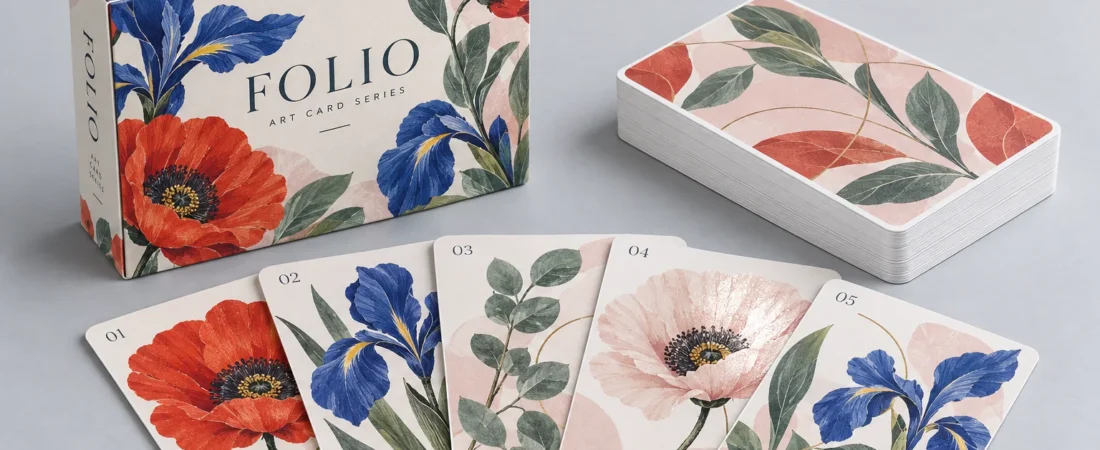
Consider a hypothetical botanical art collection. The front presents an original illustration; the reverse adds the artist’s observation and a related sketch; a contents card explains the sequence. The extra value comes from the editorial perspective, not a claim that a plant image is rare. Any factual botanical information would need its own verification.
How can a new collection feel distinctive without endless variants?
Choose one strong point of difference: a recognizable artistic voice, a well-developed fictional world, a local story with permission to use it, or a genuinely useful editorial treatment. Show that difference across several cards. A striking cover cannot prove that the rest of a set has the same depth.
For an unfamiliar brand, a small, coherent launch concept is easier to explain than many overlapping editions. That is a positioning recommendation, not a promise of better sales. Ask intended buyers to describe the product in their own words and compare their answers with your intended promise.
What should a buyer know before ordering?
- Whether the purchase contains a fixed complete set or variable contents.
- The card count, edition name and any differences between versions.
- Whether the cards are playable, decorative, informative or a combination.
- What makes the creator or licensed subject relevant to the collection.
- Whether a claimed edition limit is genuine and how later editions will differ.
Do not imply guaranteed resale value or use artificial scarcity to substitute for product value. When planning future sets, explain what is new instead of making previous buyers feel their complete product has become incomplete. A clear contents list can be more persuasive than another unexplained rarity label.
Frequently asked questions
Do collectible cards need game rules?
No. An art or reference set can stand on its own. If there are no rules, describe it as a collection rather than suggesting a playable trading card game.
Does every card need a special finish?
No. Select finishes after defining the content and viewing experience. A visual hierarchy should help the collection make sense, not obscure artwork or information.
Build the brief around the collection
Bring a representative group of card fronts and backs, a contents outline and the intended audience. View trading and collectible card formats or contact Max Deck Print to discuss a physical set. We quote custom printing and packaging from 1,000 complete sets; commercial demand and collection strategy need validation before production.