By Max Deck Print | Product development guide | September 2026
Useful conversation card design combines a specific social setting, prompts people can answer and clear permission to participate at their own comfort level. A large stack of broad questions is not automatically a satisfying product. Buyers need to understand when they would use it and why the exchange would feel different from ordinary small talk.
For gift brands, facilitators and independent creators, the challenge is not simply writing more questions. It is creating a repeatable social experience without making participants feel interviewed, exposed or obliged to perform.
Which conversation is the deck meant to support?
A family dinner, a gathering of new acquaintances and a workplace workshop have different boundaries. A question that feels warm among close friends may feel intrusive when a manager asks it. Define the relationship, setting and purpose before building the question bank.
Write a product promise that describes the occasion: “Short story prompts for family meals” or “Low-pressure introductions for a group meeting.” Neither needs to promise deeper relationships or a measurable wellbeing result. A narrower use can make the product easier to understand and easier to recommend.
Why do generic questions fall flat?
A very broad question can require too much searching before anyone knows how to begin. A yes-or-no question may close the exchange immediately. A leading question can imply that there is an acceptable answer. Review the action each prompt invites: recalling a moment, describing a preference, imagining a situation or asking a follow-up.
The examples below are original editorial suggestions, not validated prompts or a tested commercial set. Their purpose is to show how greater specificity can make the requested response clearer.
| Broad starting point | More specific alternative | Product intent |
|---|---|---|
| What makes you happy? | What small part of an ordinary weekend do you look forward to? | Invite an everyday example rather than a life summary |
| Tell us about your childhood | Was there a game you liked to play after school? You can choose a recent game instead. | Offer a clear memory cue and an alternative |
| What is your biggest dream? | What would you enjoy learning just for fun? | Keep an icebreaker lower-pressure |
| Do you like travelling? | What makes a place feel welcoming to you? | Allow an answer without assuming travel experience |
How do you create depth without pressure?
Depth should be an option, not a requirement to finish the game. Group cards by type of exchange, such as everyday stories, preferences and reflection, with plain descriptions. Let a group choose a category rather than implying that everyone must progress to more personal questions.
Include a straightforward participation rule: anyone may pass or select another card without explanation. Avoid penalties for passing. In professional or mixed groups, do not depend on disclosures about health, money, family circumstances or intimate relationships to make the product interesting.
What makes it a conversation rather than a questionnaire?
Build in room to respond. One optional follow-up such as “What made that stand out?” can keep a story moving, but participants should not feel obliged to interrogate each other. State whether the group answers the same card or takes turns choosing cards, and offer a natural stopping point.
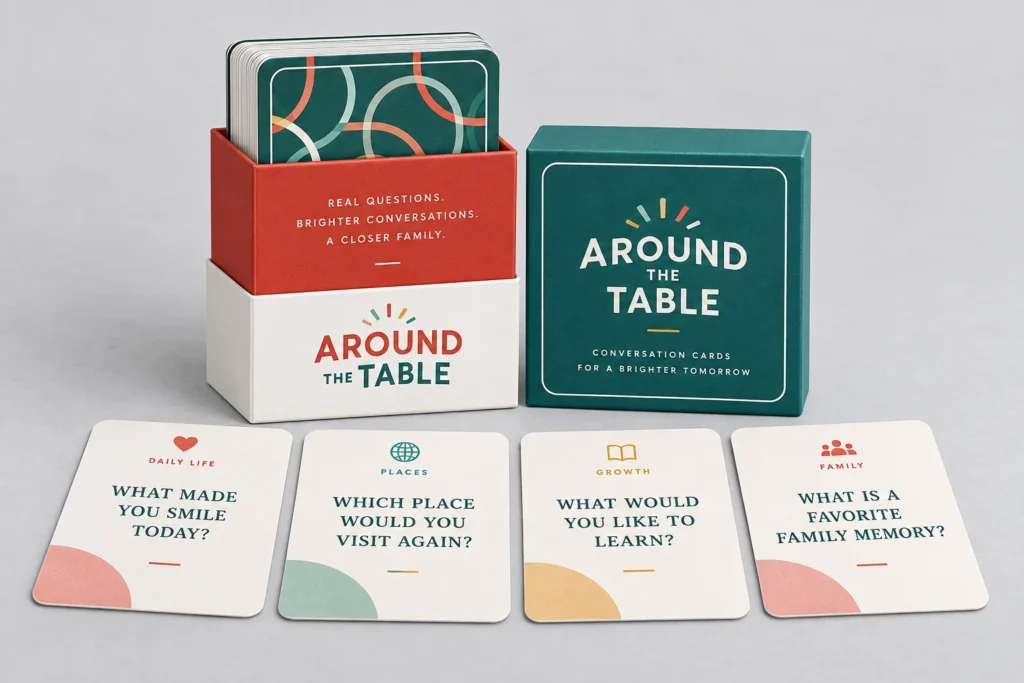
For a hypothetical family deck, a brief round might invite one story from each willing participant, followed by choosing a favorite moment from the conversation. A workshop deck may instead end with a voluntary practical observation. These formats serve different needs and should be tested with their intended users.
How can the deck remain useful after the first evening?
Repeated use can come from a changing context, not an endless supply of intimate questions. People may revisit an everyday prompt after a different week, select a new category or use the deck with another group. A simple contents guide helps them choose a suitable activity without rereading the entire instruction booklet.
Test repeat use rather than assuming it. Observe whether users select cards willingly, skip similar prompts repeatedly or struggle to understand the tone. Ask when they would actually take the box out again. Do not convert a friendly test session into a claim that the product improves relationships.
Frequently asked questions
Should conversation cards include very personal questions?
Only if that matches a clearly described audience and setting, with genuine choice about participation. Personal disclosure is not a universal measure of a successful conversation.
Is a conversation deck a therapy product?
Not by default. Describe a general-purpose deck as prompts or activities. Do not claim diagnosis, treatment or therapeutic outcomes without appropriate professional and evidentiary support.
Create a product brief around the occasion
Choose the audience, tone, categories, instructions and expected contents before finalizing the physical format. Explore custom conversation and prompt cards or contact Max Deck Print about a printed set. Bulk production starts at 1,000 complete sets. Content suitability and validation belong to the creator; we help turn the agreed contents into cards and coordinated packaging.