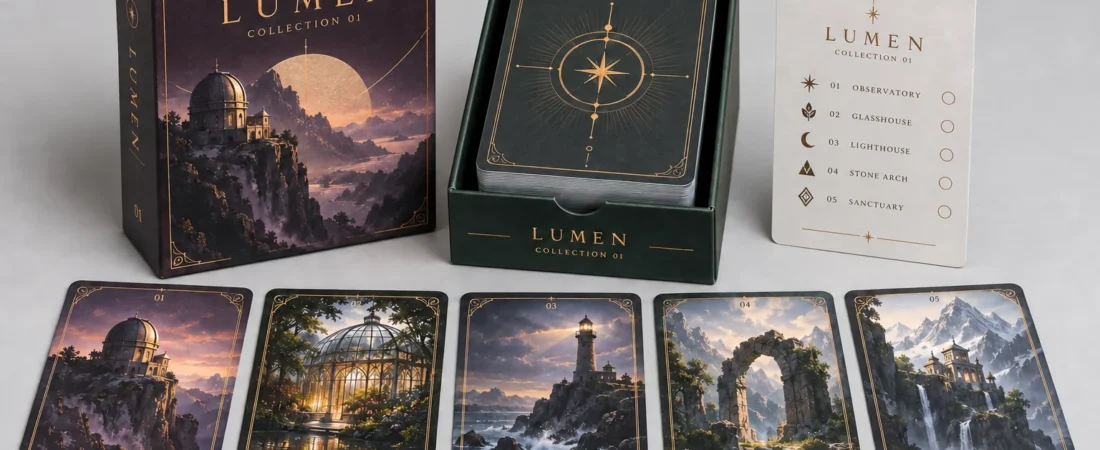
By Max Deck Print | Buyer guidance | September 2026
A premium trading card still needs to work as a card. Before specifying foil, protect the readability of the title, rules and gameplay symbols. Define the exact effect area and production method, then review a physical sample under more than one lighting angle.
A dramatic digital mockup can hide an awkward product: rules disappear in reflections, fine decoration becomes difficult to reproduce, or a quote covers a different effect from the one the designer intended. The solution is to turn the visual idea into a clear finishing brief.
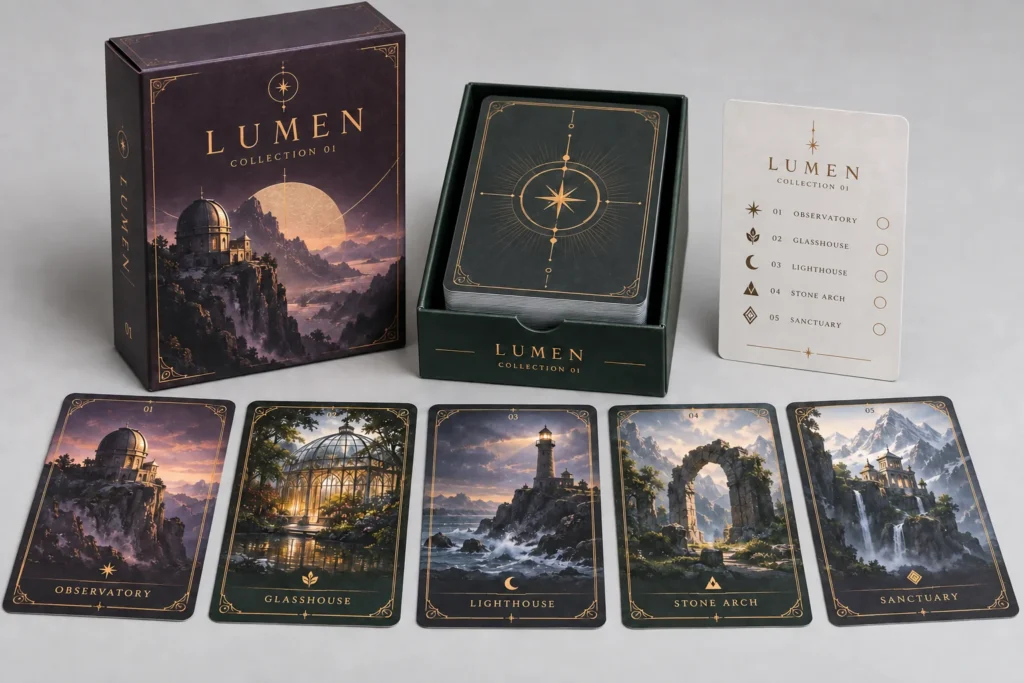
What does “foil card” actually mean?
The phrase is not a complete production specification. It may refer to selected foil-stamped details, printing over a metallic surface, a diffractive effect, or a combination of processes. A gold-colored CMYK illustration is another possibility, but it is not automatically a reflective foil finish.
KURZ distinguishes hot stamping, cold transfer and digital transfer as different decoration routes. For a custom card order, ask which route is being proposed and whether it is compatible with the selected stock and coating. Availability must be confirmed for the project; a visual reference does not establish capability.
| Vague request | More useful instruction |
|---|---|
| Make the card shiny | Show a physical effect reference and identify the exact areas |
| Gold everywhere | Separate decorative areas from rules, icons and numbering |
| Use this holographic look | Confirm the pattern, process and effect direction on a sample |
| Match the mockup | Approve a named physical reference under agreed viewing conditions |
| Same finish on every card | List whether effect artwork is shared or different for each design |
Where should the reflective effect stop?
Start with the information a player must read quickly. Keep rules and numeric values on a controlled, legible background. Use decorative accents around the artwork, title frame or selected symbols only when the effect supports the intended design.
Review the card flat on a table, held in a hand and viewed across the playing area. Rotate the sample under ordinary room lighting. A finish that photographs well at one angle may be distracting in play. Have someone unfamiliar with the layout find the card name, cost and main instruction without prompting.
Collectors and game players can have different priorities. A display-focused art card may tolerate a more extensive reflective effect than a rules-heavy game card. Define the intended use before treating the most elaborate option as the best option.
What files does the finishing brief need?
Supply the base artwork and a clearly identified effect separation using the printer’s instructions. Include a composite reference showing how the layers relate. Do not create an effect layer by guessing at a template from an unrelated printer.
Adobe explains that spot colors and process colors serve different print roles, including separate plates for selected varnish areas. A spot-color name in a PDF communicates a separation; by itself it does not specify foil material, machine settings or the final physical appearance.
- Identify the front or back receiving the effect.
- List the designs and quantities using each effect mask.
- Ask for minimum line, gap and text requirements for the selected process.
- Confirm how the effect relates to trimming, rounded corners and other coatings.
- Request clarification of overlapping layers and overprint settings before approval.
How can buyers keep the finish from expanding the budget?
Ask for separate quotations for a restrained accent and a more extensive treatment using the same base card specification. Identify any additional setup, tooling, unique effect artwork and sample charges. Do not assume that a smaller visible area always means a lower final price; the manufacturing route and setup can matter as much as coverage.
If the effect is optional, consider keeping gameplay cards simpler and placing the premium treatment on a title card or packaging. Confirm the revised contents and packing plan so that a special card is not accidentally counted as an additional game component.
Frequently asked questions
Can an on-screen proof approve the foil appearance?
It can help approve placement and artwork. It cannot reproduce the changing reflections, texture or handling of a physical finish. Confirm what the supplied proof is intended to demonstrate.
Can foil, spot UV and lamination be combined?
Some combinations are possible, but sequence and compatibility need project-specific review. Request one sample representing the proposed construction, not separate swatches that demonstrate each effect independently.
Does a gold color in the design automatically request foil?
No. Mark the intended effect explicitly in the specification and use the agreed artwork separation. Otherwise a gold-colored area may simply be printed using ordinary process inks.
Turn the visual reference into a quoteable specification
For custom trading and collectible cards, send Max Deck Print a reference image, card size, unique design count, copies per set and the desired effect areas. Request a project review for bulk production from 1,000 complete sets; finishes and sample costs are confirmed after review.